Pest guide · Nampa, Idaho
Ant Trails in Nampa Homes, From Canal Banks to Countertops
- Reviewed by a licensed Idaho pest professional
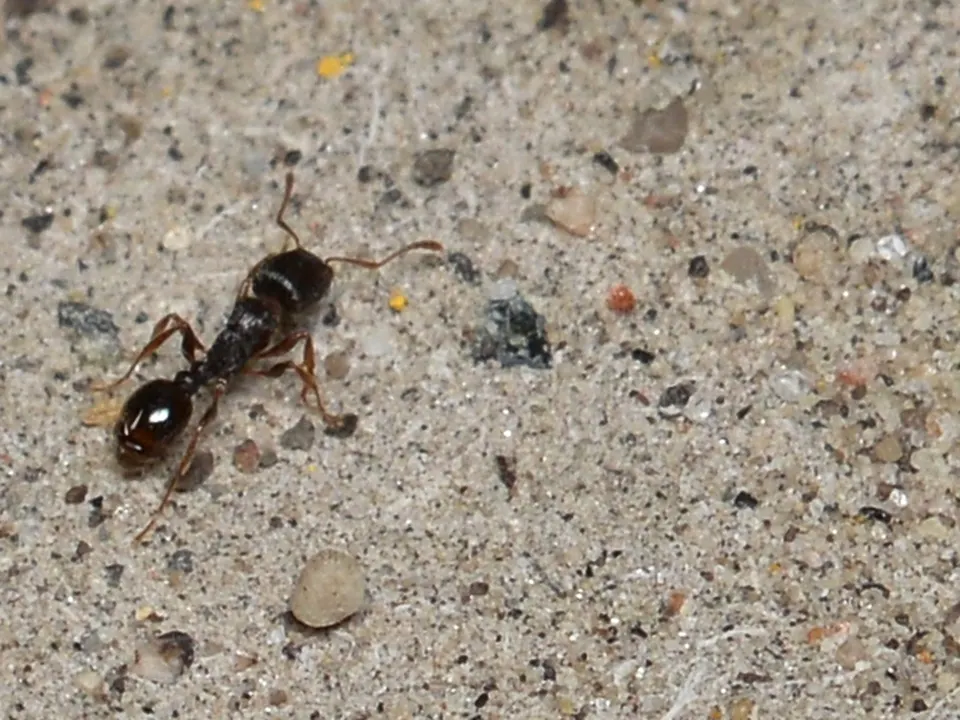
When Nampa homeowners find ants marching along a baseboard or across a counter, they are usually dealing with small, dark trailing species. Pavement ants, which nest under slabs and sidewalks, are one common culprit. Odorous house ants are another, and the regional Extension publication PNW 624 lists them across the Pacific Northwest.
Both ants are looking for moisture and something to eat. Nampa has irrigation laterals laced through town, Indian Creek running through the area, and farm ground still bordering homes toward Happy Valley Road and Karcher Road. Damp soil is rarely far from a foundation here. A licensed professional looks for where the colony actually lives, not just at the workers you happen to see.
What pulls ants toward Nampa houses
Nampa grew up around irrigation. The city’s published history credits the Phyllis Canal and the Ridenbaugh Canal extension, both finished in the early 1890s, with turning sagebrush into farmland around town (City of Nampa). Many canals and laterals still cross neighborhoods today.
Watered lawns, garden beds and park ponds like the one at Lakeview Park add even more moisture. Together they keep soil near houses damp, even though the valley’s official weather station records summers as hot and dry (NWS Boise). Ants settle into that moist ground and forage outward from it.
Food gives them a reason to come inside. Pet dishes, garbage bins in the garage, spilled drinks and pantry crumbs all draw foragers. When canal water is shut off in fall and yards dry out, foragers may also come indoors looking for water.
Both older and newer homes see ants. Downtown buildings around 1st Street and Front Street have aging gaps and joints, and some of them were rebuilt after the 1909 fire. Newer houses along the Midland Boulevard corridor and out toward I-84 often sit on former farm soil, where ants can move in as landscaping fills in.
Telling common Nampa ants apart
- Odorous house ant. Tiny, about an eighth of an inch or a little less, and one even shade of dark brown to black. Workers tend to move in long, steady lines and favor sugary food.
- The smell clue. When crushed, these ants can give off a sour odor that many people compare to rotten coconut (PNW 624, full text). Some other ants smell much the same, so treat the odor as a hint rather than proof.
- Pavement ant. Similar in color and slightly sturdier. Pavement ants often leave small piles of sand or soil along sidewalk cracks, driveway joints and the edges of a garage slab.
- Where nests tend to be. Around Nampa homes, look to damp soil near sprinkler heads and laterals, under landscape rock and edging, beneath slabs, and inside wall voids.
- What kind of problem it is. Regional guidance treats these ants as nuisance household pests (PNW handbook). They are not known for harming sound wood. The real concern is ants crossing food, dishes and prep surfaces.
Signs it’s time for a professional look
It may be worth requesting a quote if:
- Ants keep returning to the same spot week after week.
- You see them in the kitchen and a bathroom or bedroom at the same time.
- Trails vanish into an outlet, baseboard or wall.
- They keep turning up where you cook or store pet food.
- Sand piles along the driveway or garage slab come back after rain or irrigation. That usually means an established colony is close by.
What licensed ant work usually involves
- Confirming the species. Pavement ants and odorous house ants nest differently and respond differently to bait, so identification comes first.
- Inspecting inside and out. The technician checks foundation edges, sprinkler lines, utility openings and landscaping against siding to trace where foragers are coming from.
- Baiting active routes. The Pacific Northwest Insect Management Handbook calls bait the most effective tool against ants in a building, especially odorous house ants (PNW handbook). Foragers carry it back and share it with the colony, so results build over days or weeks rather than overnight.
- Keeping the colony from splitting. Repellent sprays or a disturbed nest can push odorous house ants to break into several new nests. Product choice and placement are part of why Idaho requires a license to apply pesticides for hire.
- Checking back. A follow-up visit shows whether trails have actually stopped or whether a second nest is still feeding them.
This guide explains what to expect from licensed professional work. It is not a substitute for that work.
Request a free quote for ants in Nampa
Recommended local provider
Describe what you are seeing and request a free quote. Requests are passed to a licensed local provider. This guide recommends ProGuard Pest Control, a local, family and veteran owned company that is licensed and insured. Treatments are family and pet safe.
- Local, family and veteran owned
- Licensed and insured
- Family and pet safe
- Free quote
- Serves Nampa, Idaho
Ant questions from Nampa homeowners
My house isn’t near a canal. Why do I still have ants?
A canal isn’t required. Lawn sprinklers, drip lines, flower beds and a shady north wall can keep soil damp enough for a colony. In Nampa, most yards get regular summer watering, so suitable nesting ground is common even blocks away from a lateral.
What are the little piles of sand along my driveway?
Those piles are often a sign of pavement ants. Workers carry soil up from nests under concrete and leave it at cracks and joints. The piles tend to reappear after watering or rain.
Do ants disappear once Nampa gets cold?
Outdoor activity slows a great deal in winter. A colony nesting under a heated slab or inside a wall can stay active, though, so some homeowners still see a few ants indoors during colder months.
Can kitchen ants make my family sick?
The regional handbook treats these ants as nuisance pests rather than a serious health threat. Still, they walk through garbage and then across food and dishes, which is why trails in a kitchen are worth addressing.
How soon will ants stop after professional baiting?
It varies with the species, the size of the colony and how many nests are involved. Bait works as foragers share it, so it is gradual. This guide does not make promises about outcomes or timing, and a follow-up visit is the usual way to confirm progress.
Sources
- University of Idaho Extension, PNW 624, ants of the Pacific Northwest
- PNW 624 full text (Washington State University)
- Pacific Northwest Insect Management Handbook, nuisance household ants
- National Weather Service, Local Climate of the Treasure Valley
- City of Nampa, History of Nampa
Each link points to the university, weather service or city page that supports the statement it follows.
More from this guide
Other household pests Nampa residents ask about
Need help with a pest in Nampa?
Describe what you are seeing and request a free quote. Requests are passed to a licensed local provider.